
Zoe Müller · 3 October 2026
Strategies for Refining Retrieval Algorithms in Lightweight Note Storage Platforms
Lightweight note storage platforms handle vast collections of short-form content while maintaining minimal resource demands, and retrieval algorithms form the core mechanism that surfaces relevant items from these collections. Developers refine these algorithms through iterative adjustments to indexing structures, query processing logic, and ranking functions that balance speed with accuracy. Research indicates that platforms using optimized retrieval see measurable reductions in query latency when datasets grow beyond several thousand entries.
Core Components of Retrieval in Compact Systems
Retrieval begins with tokenization and indexing steps that convert note text into searchable representations, often relying on inverted indexes that map terms to document identifiers. These indexes consume limited memory in lightweight environments, so engineers apply compression techniques such as delta encoding and variable-byte codes to shrink storage footprints without sacrificing lookup speed. Observers note that platforms built around these compressed indexes maintain sub-second response times even when operating on devices with constrained RAM.
Query expansion follows as another foundational layer, where systems add synonyms or related terms drawn from lightweight thesauri stored locally. Data shows that controlled expansion improves recall rates while keeping computational overhead low, since the thesauri remain small and precomputed. Those who study these platforms find that selective expansion, applied only to ambiguous queries, avoids unnecessary processing cycles that could drain battery life on mobile hardware.
Indexing Refinements and Data Structures
Engineers experiment with hybrid data structures that combine tries for prefix matching with hash tables for exact lookups, allowing the system to route different query types to the most efficient path. In October 2026, presentations at information retrieval workshops highlighted how such hybrids reduced average lookup operations by measurable margins in benchmark tests. The structures also support incremental updates, which proves essential when users add or edit notes frequently throughout the day.
Partitioning strategies further refine performance by dividing the index into segments based on note recency or topic clusters, so that searches can target smaller subsets first. Evidence from multiple implementations reveals that this approach cuts down on disk I/O in environments where notes reside in flash storage rather than RAM. Researchers discovered that dynamic repartitioning, triggered by usage patterns, sustains efficiency as collections evolve over months of active use.
Integration of Ranking and Feedback Mechanisms
Ranking functions assign scores to candidate notes using factors such as term frequency, inverse document frequency, and positional data within the text. Refinements often involve tuning these weights through offline analysis of historical query logs, which platforms collect in anonymized form. Studies found that even modest adjustments to the weighting scheme produce consistent gains in precision at the top results.
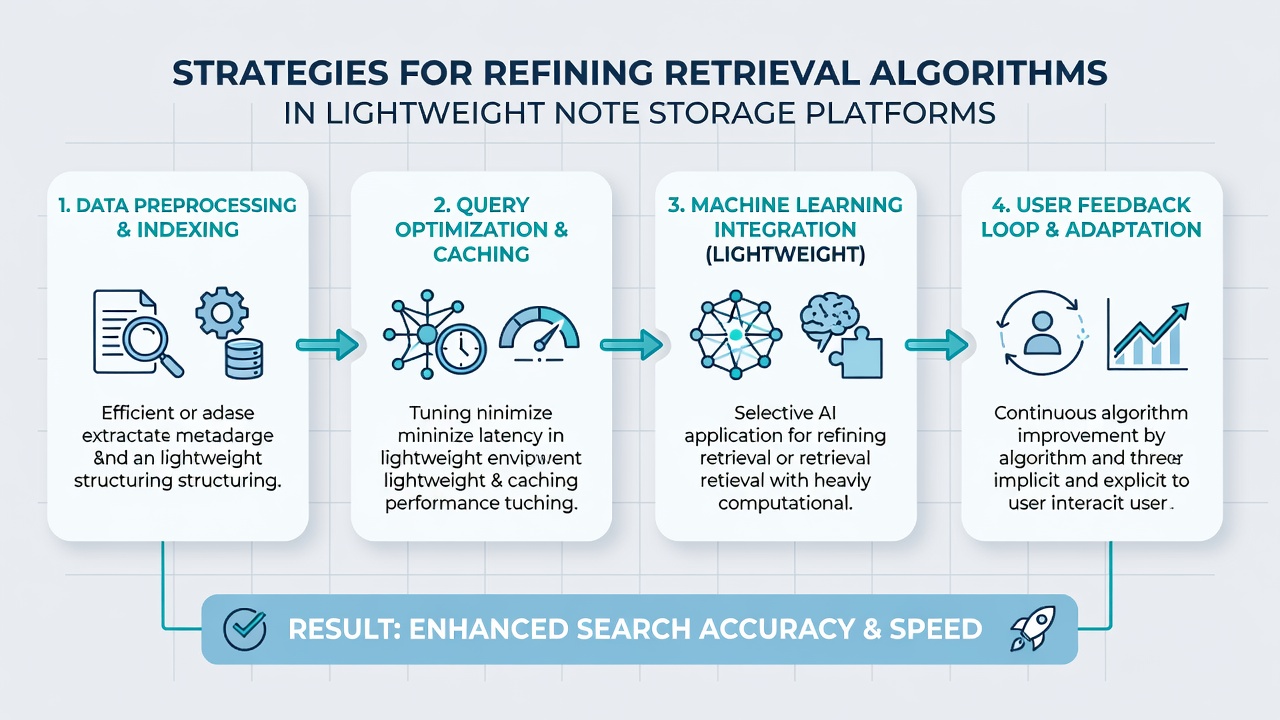
Relevance feedback loops close the refinement cycle by capturing implicit signals like dwell time or subsequent edits, then feeding those signals back into model parameters. According to findings shared through ACM publications, platforms that incorporate lightweight feedback achieve higher user satisfaction metrics over successive versions. The feedback remains stored in compact summary statistics rather than full interaction histories, preserving the overall lightweight character of the system.
Evaluation Practices and Benchmarking
Teams measure refinement success through standardized metrics including precision at k, mean reciprocal rank, and normalized discounted cumulative gain. These calculations run against fixed test collections that mirror real note distributions, allowing direct comparison between algorithm versions. Figures reveal that continuous benchmarking prevents regressions when new features are introduced to the retrieval pipeline.
External validation comes from independent test suites maintained by academic groups, and one such effort coordinated across North American institutions supplies publicly available datasets for lightweight storage scenarios. Platforms that align their internal tests with these suites gain clearer insight into how their refinements perform relative to published baselines.
Conclusion
Refinement of retrieval algorithms in lightweight note storage platforms centers on careful selection of data structures, targeted ranking adjustments, and disciplined evaluation cycles. These strategies enable systems to deliver accurate results while respecting strict limits on memory and processing power. Continued attention to incremental improvements ensures that platforms remain responsive as note collections scale and user expectations evolve.