
Lars Schmid · 14 November 2026
Navigating Data Portability Challenges Across Minimalist Knowledge Repositories
Minimalist knowledge repositories focus on lightweight structures that store notes, references, and metadata in simple file formats, yet moving that content between platforms creates persistent technical hurdles. Data portability requires transferring information while preserving structure, links, and context, and compact systems often limit export options to basic text files that strip away relational elements. Researchers have documented how these repositories rely on plain text or markdown files, which function well within a single application but lose connections when imported elsewhere.
Core Elements of Minimalist Repositories
These repositories typically use flat file systems with minimal databases, and they emphasize quick access over complex querying. Observers note that formats like markdown combined with YAML front matter handle basic metadata, while attachments remain separate files in linked folders. Studies indicate that this approach reduces overhead but complicates transfers because external tools may interpret links or tags differently. In November 2026, updates to interoperability standards are scheduled to address some of these format mismatches across regions including the European Union and Australia.
Primary Challenges in Data Movement
Link resolution stands out as a frequent issue since internal references break when folder structures change during export. Metadata such as creation dates, custom tags, and backlinks often fails to transfer intact because target systems use different schemas for storing that information. Experts have observed that attachment handling adds another layer of difficulty, as embedded images or documents require separate mapping to avoid broken paths. Data shows that users managing large collections encounter cumulative errors when moving thousands of files, and partial imports leave gaps in reference networks.
Format Compatibility Issues
Minimalist tools frequently default to markdown or plain text, yet variations in syntax for tables, code blocks, and embedded queries create conversion problems. One study revealed that certain lightweight platforms add proprietary extensions that standard parsers reject, forcing manual cleanup after migration. While basic text survives the move, advanced features like inline calculations or dynamic embeds require custom scripts to preserve functionality across environments.
Regulatory and Technical Context
Regulations in multiple jurisdictions now emphasize user control over personal data, and this extends to knowledge repositories that individuals maintain for research or professional use. According to guidance from the Office of the Australian Information Commissioner, organizations must support portable formats that allow individuals to retrieve their information without undue burden. Technical standards developed by the World Wide Web Consortium provide frameworks for structured data exchange, and these resources help developers align export functions with broader portability expectations.
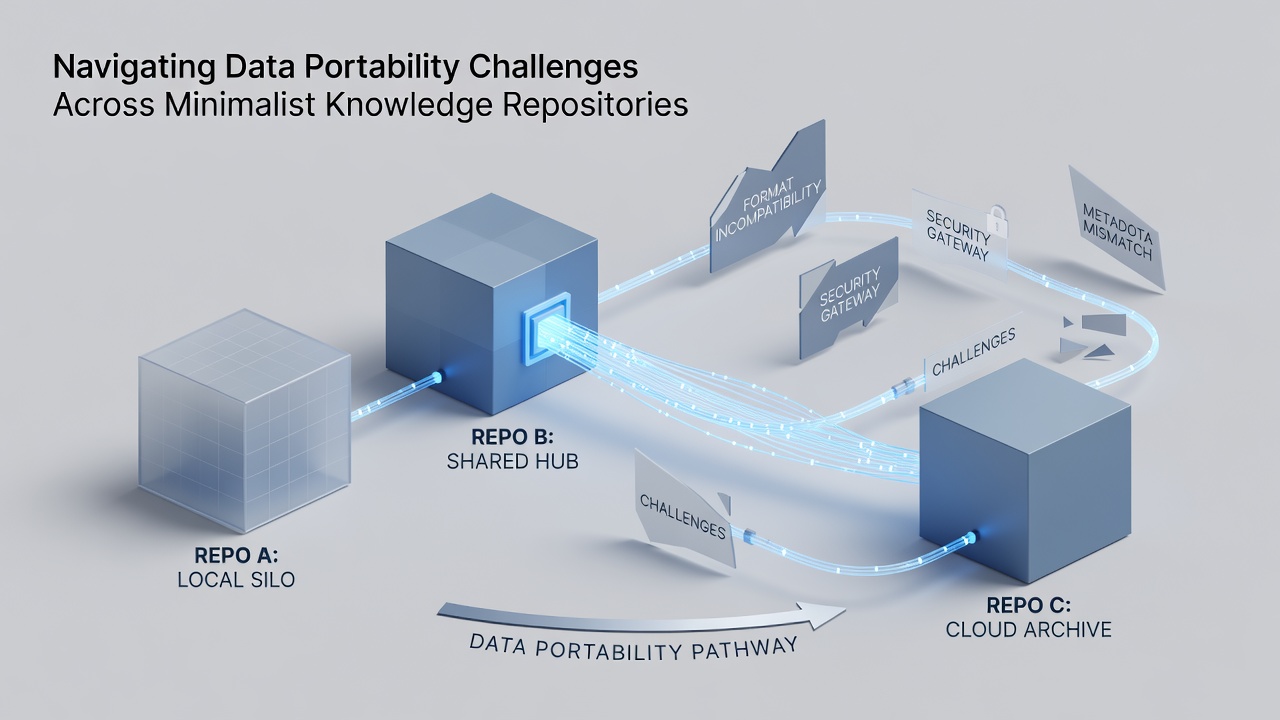
Implementation remains uneven across tools because many minimalist applications prioritize speed and low resource use over full compliance features. Those who have examined migration logs report that date fields and author attributions frequently default to system timestamps on import, erasing original context. Custom taxonomies created by users also face translation barriers when target platforms lack equivalent category structures.
Approaches That Address Portability
Developers have introduced intermediate conversion layers that map source fields to common interchange formats such as JSON-LD or RDF before final import. These layers allow preservation of relationships that would otherwise disappear during direct file copies. Research indicates that batch processing tools can scan repositories for broken links and suggest corrections, reducing manual effort after a transfer completes. Organizations that maintain personal archives often adopt version-controlled storage alongside their repositories, enabling rollback if a migration introduces inconsistencies.
Case examples show that researchers who maintain separate index files outside the main repository achieve more reliable transfers because the indexes remain independent of any single application format. Data from industry reports highlights that combining open standards with automated validation scripts improves success rates across different minimalist platforms. The process still requires testing because each tool implements file handling in distinct ways.
Outlook for Improved Interoperability
Continued work on open data exchange protocols aims to reduce friction in future transfers, and several academic projects focus on lightweight ontologies suited to compact repositories. Observers expect that by late 2026, more applications will incorporate built-in export validation that checks for common issues before files leave the source system. This development could lower the incidence of lost metadata and broken connections during moves between environments.
Conclusion
Navigating data portability in minimalist knowledge repositories involves managing format differences, metadata preservation, and link integrity across systems that favor simplicity. Technical solutions such as conversion layers and validation scripts provide practical paths forward, while regulatory frameworks continue to shape expectations for user-controlled data movement. Progress depends on consistent adoption of interchange standards that respect the lightweight nature of these repositories without adding unnecessary complexity.